


Getting itchy dogs back to normal
Zenrelia™ gets 45% more itchy dogs back to normal than Apoquel®1**
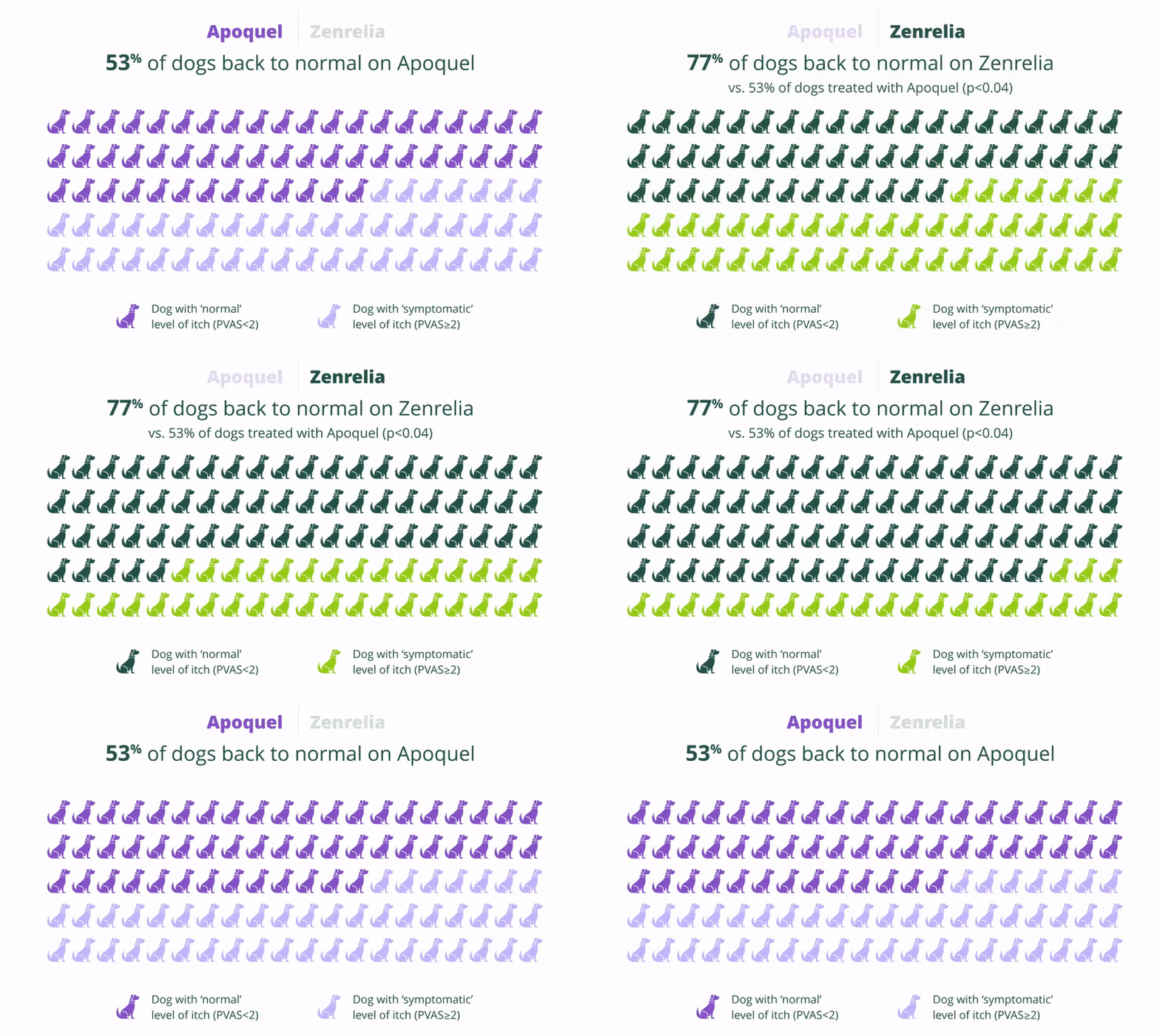
A higher proportion of dogs treated with Zenrelia achieved a PVAS (Pruritis Visual Analogue Scale) score of less than two by day 112, compared to dogs treated with Apoquel. A 'normal' itch score is considered to be comparable to that of a healthy, non-allergic dog (PVAS<2)1.
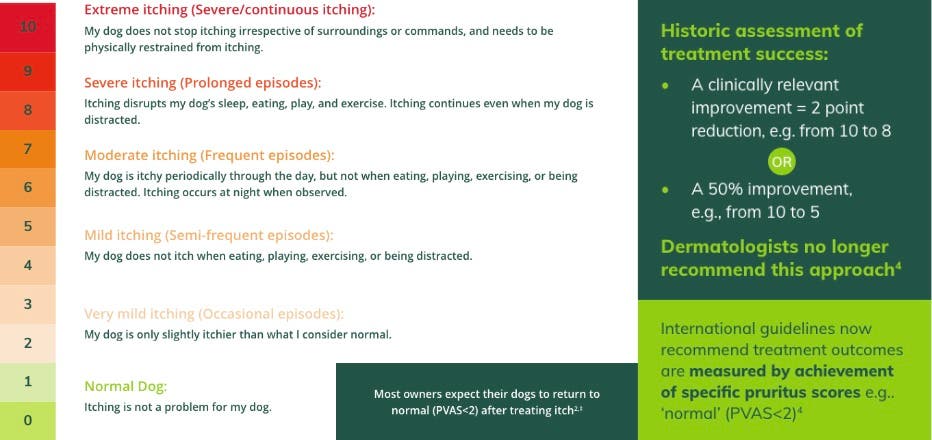

Veterinary expert on raising expectations with itchy dogs

"When they interviewed the clients with pets with skin disease, they asked what they were expecting after treatment. Only 12% of clients would have been happy with a 50% improvement in itch, and actually 79% of clients expected their pet to go back to normal”
Dr Victoria Robinson BVM&S, BSc, CertAVP (VD), DipECVD, MRCVS
RCVS and European Specialist in Veterinary Dermatology

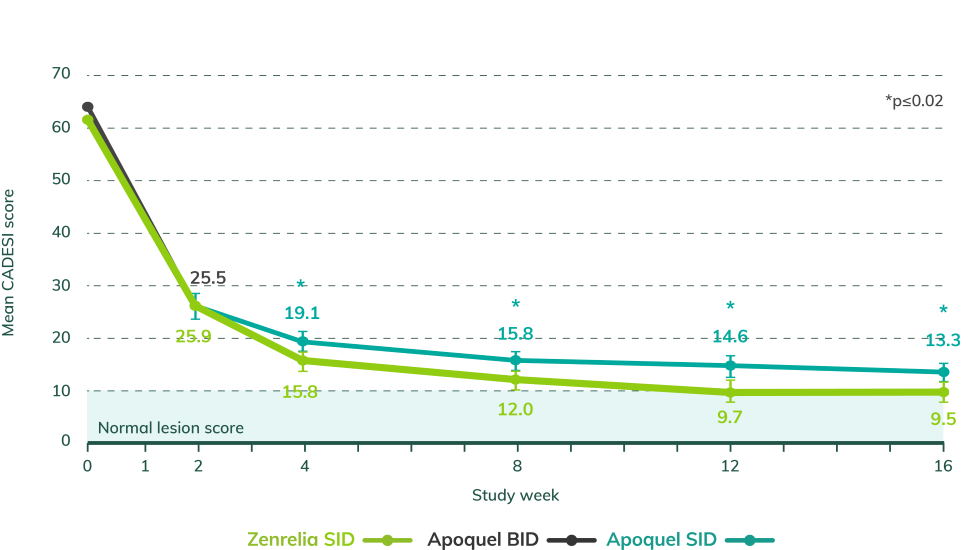
Zenrelia offers significant improvement in skin lesions vs. Apoquel from day 281†††
The Canine Atopic Dermatitis Extent & Severity Index (CADESI) is a tool to help measure the level of skin lesions in dogs, used widely in clinical studies.5
Vet-assessed skin lesion score (CADESI-04)
How Zenrelia works
Zenrelia is the only JAK inhibitor for dogs with high potency for JAK1, JAK2 & TYK2, key JAK enzymes involved in itch and inflammation¥, 6-8. By targeting multiple JAK enzymes & inhibiting the function of several cytokines involved in itch and inflammation, Zenrelia gets more itchy dogs back to normal than Apoquel, with a comparable safety profileᆆ1,6,7,9,10.
The best way to evaluate a JAK inhibitor efficacy and safety is through head to head real-world studies10,11. JAK selectivity based on in vitro assays shouldn't be used in isolation to evaluate product efficacy and safety11.
Questions?
Zenrelia Resources
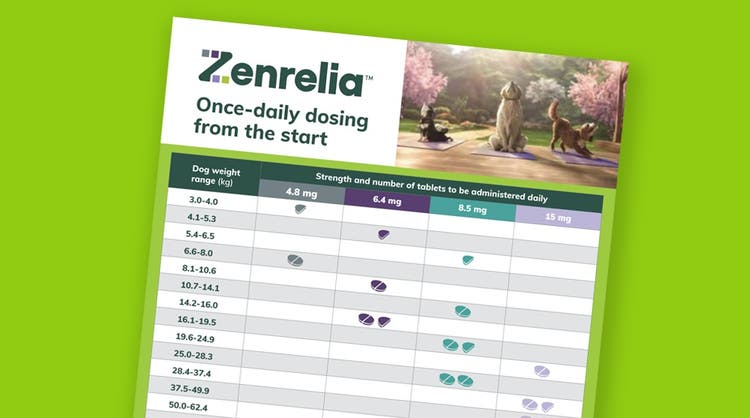
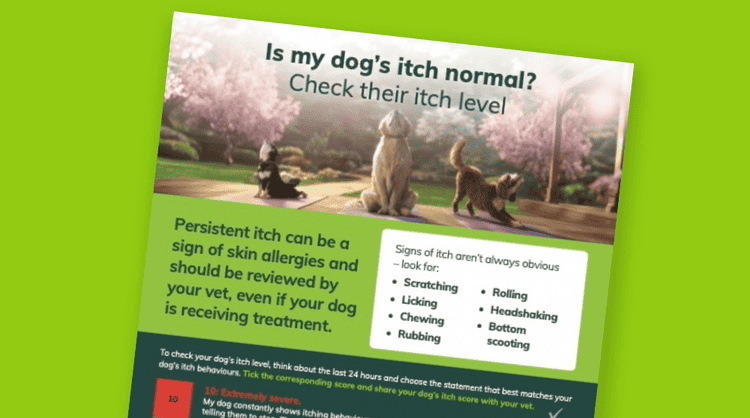
Owner Pre-Prescription Tear Off Pad
Support owners with tracking their dog's itch level.
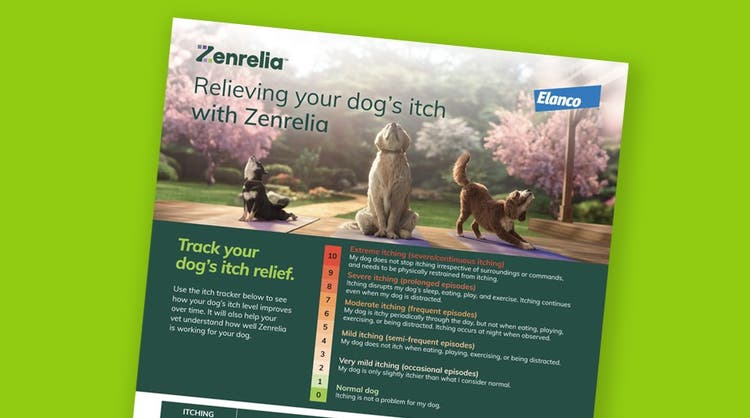
Owner Post-Prescription Itch Tracker
Support owners with dogs on Zenrelia to track their itch.

Itchy Dog Social Media Toolkit
Encourage owners of itchy dogs to check their itch levels and discuss treatment options with your team.
* Referenceable claims in digital & social copy can be found on this page. Full reference list below.
** 77% of dogs treated with Zenrelia achieved PVAS <2 by day 112 compared to 53% of dogs treated with Apoquel. A ‘normal’ itch score is considered to be comparable to that of a healthy, non-allergic dog (PVAS <2)1.
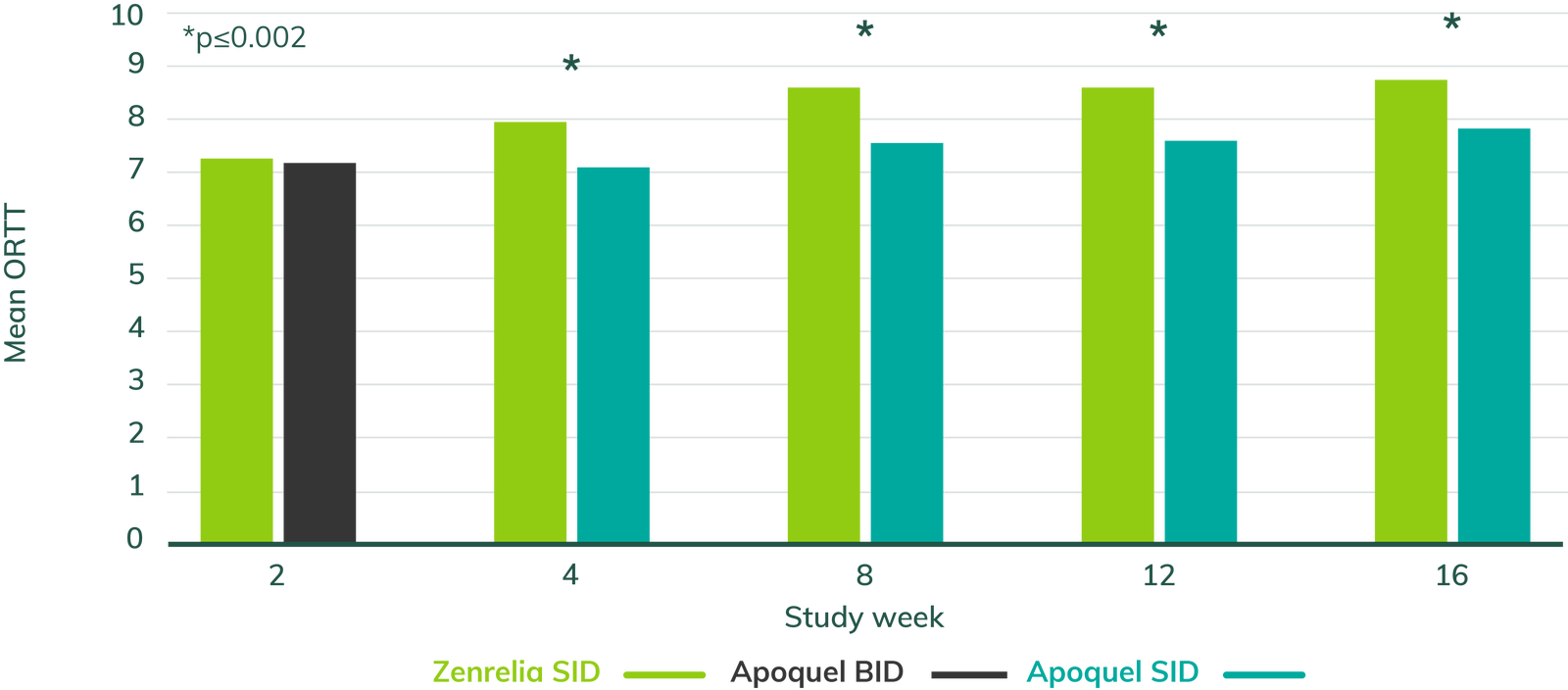
†Response to treatment was assessed using a simple VAS scale graded from 'no improvement' at 0 cm to 'excellent improvement' at 10 cm1.
††A ‘normal’ itch score is considered to be comparable to that of a healthy, non-allergic dog (PVAS<2)1.
†††Improvement based on mean CADESI-04 scores from Day 28. A CADESI-04 score of <10 is comparable to that of a healthy, non-allergic dog1.
‡ 79% of owners expect a PVAS of 0-1.92.
¥ Multiple JAK enzymes are involved in itch and inflammation, in particular JAK1,JAK2 & TYK211.
α Proinflammatory & pruritogenic cytokines implicated in allergic skin disease & allergic responses include IL-2, IL-6, IL-4,, IL-13 & IL-317.
BID, twice-daily; IRTT, investigator-assessed response to treatment; ORTT, owner-assessed response to treatment; PVAS, pruritus visual analogue scale; SID, once daily; VAS, visual analogue scale.
- Forster S et al. Vet Dermatol 2025 Apr,36(2):165-176.
- Rybnícek J. et al. Vet Dermatol 2009;20(2):115–122.
- Hill P. B. et al. Vet Dermatol 2007;18(5):301–308.
- Olivry T et al. BMC Veterinary Research 2018;14:238
- Olivry T et al. Vet Dermatol. 2014 Apr;25(2):77–85, e25.
- Unpublished data: JAK selectivity profile report.
- Gonzalez AJ et al. J. vet. Pharmacol. Therap. 37, 317--324.
- Howell MD, Kuo FI and Smith PA. Front. Immunol 2019;10:2342. doi: 10.3389/fimmu.2019.02342.
- Zenrelia Summary of Product Characteristics.
- Virtanen A, et al. Arthritis & Rheumatology. 2023 Nov;75(11):2054-61.
- Bonelli M, et al. Ann Rheum Dis 2024;83:139-160.
Lin CM, Cooles FA, Isaacs JD. Mediterr J Rheumatol. 2020 Jun 11;31(Suppl 1):100-104.
