


Improve productivity with Hemicell™ XT
Optimal productivity depends on maximising the energy available in feed
The cost of feed vs. productivity underpins the profit margin of pig production. Managing and maximising the nutritional margins of feed is therefore a powerful way to increase profitability.
Soybean meal is an affordable, digestible protein source with good amino acid balance but, like many other vegetable feed ingredients, it contains beta-mannans.1,2
Beta-mannan content of common feed ingredients

Palm kernel meal: 7.24%
Soya hulls: 6.67%
Soybean meal: 0.67%
Sunflower meal: 0.60%
Distillers Dried Grains with Solubles (DDGS): 0.57%
Oats: 0.31%
It is recommended to use Hemicell XT for any diet with at least 0.2% soluble beta-mannan content.

Beta-mannans have a negative impact on productivity:

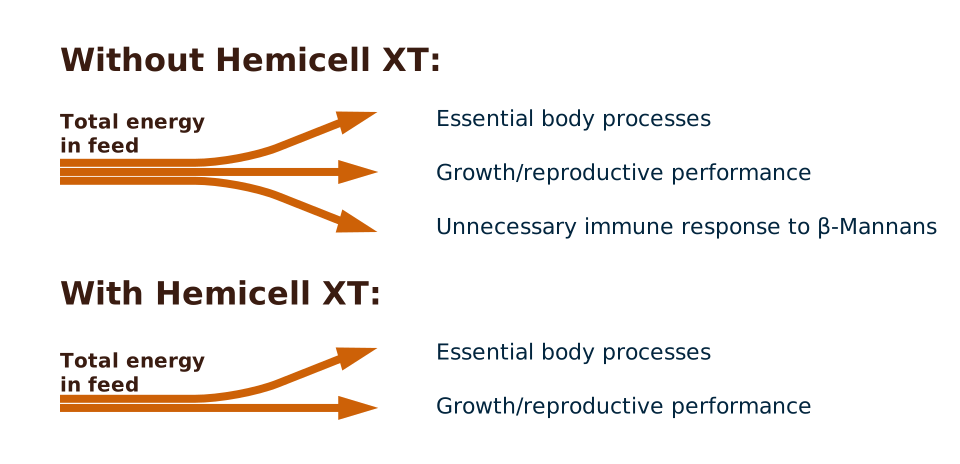
Reduce feed efficiency by diverting energy towards an unnecessary immune response3-7

Reduce productivity by up to 3%, even under good commercial conditions8-10
Access our study data page for more information

Hemicell XT eliminates the damaging effects of beta-mannans11
As a beta-mannanase enzyme, Hemicell XT breaks down beta-mannans before they are able to prompt a damaging immune response.11
Maintain performance on reduced feed costs3-7
Providing assured return on investment
Hemicell XT makes more energy available from the same amount of feed:

Unlocks an additional 85-100 kcal of metabolisable energy from the diet by preventing its loss to an unnecessary immune response12,13

Access our study data page for more information
Take control of your herd’s gut health and productivity - ask for Hemicell XT in your next feed formulation
Hemicell XT: a different type of enzyme

Energy-sparing…
Hemicell XT:
Stops unnecessary, energy-wasting processes, allowing more energy already in the feed to be directed towards growth and productivity

… not energy releasing
Other enzymes:
Work to ‘open up’ feed components that the animal is unable to access on its own
Why choose Hemicell XT?
Hemicell XT provides peace of mind that the problem of beta-mannans is effectively managed with ease, promoting healthy and sustainable productivity.
Flexible and easy to use

Used in-feed

No withdrawal or restrictions when used in combination with other feed additives
Unmatched reliability

Delivers guaranteed activity levels, even after exposure to pelleting temperatures*

Backed by Elanco’s expertise in promoting gut health
*specific Hemicell products only
- Hsiao, H., Anderson, D. and Dale, N. 2006. “Levels of β-mannan in Soybean Meal.” Poultry Sci.85:1430- 1432.
- Ferrel, J., Anderson, D, and Hsiao, H.-Y. 2014. “Content of Soluble Non-Starch Polysaccharides β-Mannan and Xylan in Legume Meals, Non-Legume Meals, and Cereal Grains or Cereal Grain By-Products.” Journal Animal Science, 92: Abstract #328
- Song W, et al. (1995) A Receptor Kinase-Like Protein Encoded by the Rice Disease Resistance Gene, Xa21. Science. 270: 1804-1806.
- Beutler B, et al. (2006) Genetic Analysis of Host Resistance: Toll-Like Receptor Signaling and Immunity at Large. Annu. Rev. Immunol. 24: 353-389.
- Ausubel F. (2005) Are innate immune signaling pathways in plants and animals conserved? Nature Immunol. 6(10): 973-979.
- Didierlaurent A, et al. (2005) Innate and acquired plasticity of the intestinal immune system. Cellular and Molecular Life Sciences. 62: 1285-1287.
- Stahl P, Ezekowitz R. (1998) The mannose receptor is a pattern recognition receptor involved in host defense. Curr. Opin. Immunol. 10(1): 50-55.
- Pettey, L., Carter, S., Senne, B. and Shriver, J. 2002. Effects of s-mannanase addition to corn-soybean meal diets on growth performance, carcass traits, and nutrient digestibility of weanling and growing/finishing pigs. J. Anim. Sci. 80: 1012-1019. REF-00813
- Rambo, Z., Ferrel, J., Anderson, D. et al. 2011. “Effect of increasing concentrations of two thermal stable strains of beta-mannanase in corn-soybean meal diets on nursery pig performance.” J. Anim. Sci. 89(E-Suppl.2, abstract 224): 119. REF-01067
- Evaluation of Hemicell in Swine Nursery Feeds Using Meta Analysis of Ten Experiments. Elanco Study ENZUS140022 2014. REF-10595
- Sánchez-Uribe, et al. 2022. Effect of β-Mannanase Addition during Whole Pigs Fattening on Production Yields and Intestinal Health. Animals 2022, 12, 3012. https://doi.org/10.3390/ani12213012
- Genova JL, et al. 2023. β‑mannanase supplemented in diets saved 85 to 100 kcal of metabolizable energy/kg, supporting growth performance and improving nutrient digestibility in grower pigs. Scientific Reports 13:12546
- Genova JL, et al. 2023 β-mannanase supplementation in diets reduced in 85 kcal metabolizable energy/kg containing xylanase-phytase improves gain to feed ratio, nutrient usage, and backfat thickness in finisher pigs. Front. Vet. Sci. 10:1144692. doi: 10.3389/fvets.2023.1144692
